
Symptoms, Causes and Treatment Options
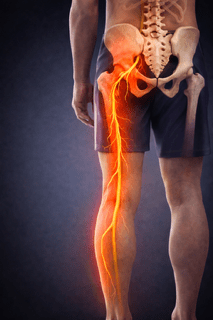
Sciatica is one of those pains that can really get people down. In nearly two decades of treating patients as a chiropractor at Active in Portsmouth, I’ve seen hundreds of people affected by it.
It’s a condition that can significantly impact quality of life, affect mood, sleep, movement and work.
My hope is that by sharing my clinical experience here, I can help you better understand what’s going on and guide you back towards a sciatica-free life.
- What This Page Will Help You Understand
My aim for you after reading this page is that you will understand:
- What is sciatica?
- Common symptoms
- What causes sciatica and what to do if you have it (practical advice)?
- Helpful products (link) and habits that may support recovery day to day
- When to seek urgent medical advice?
- What Is Sciatica?
Sciatica is actually more of a generalised term used to describe pain caused by irritation of the sciatic nerve, or more commonly, the smaller nerves that join together to form it.
Think of it like a road network. The smaller roads are the nerves that come from the low back…they join up (in the buttock) to make the Sciatic nerve (like the motorway).
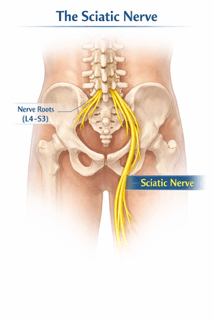
The nerve then spreads out (think of the motorway splitting into smaller roads again) and travels into the leg.
- What Are The Common Symptoms Of Sciatica?
Sciatic pain can be felt pretty much anywhere in the leg and even foot. It is most commonly only in one leg but can be both. The most common symptoms include:
- Sharp shooting pain into the buttock/leg
- Aching into the buttock, hamstring or calf
- Burning/deep nerve pains
- Tingling/pins and needles/numbness
- Heaviness in the legs
- Weakness in leg/foot muscles (more severe cases)
- Pain worse with sitting or driving
- Pain triggered with bending/coughing/sneezing/lifting
Not everybody will experience all of these symptoms and severity can vary widely.
IMPORTANT: If your type of nerve pain is triggered by standing/walking and RELIEVED by sitting/bending, this can still be sciatic pain but the advice will be different. It’s extremely important to recognise your aggravators so that you choose the right advice. Keep reading for more information, in particular the SPINAL STENOSIS section lower down.
The most common ‘classic’ pain patterns that I see in clinic are:
- Buttock → Back of thigh → Calf
- Buttock. →. Outside of thigh → Shin/top of foot
Sciatic pain vs hamstring/gluteal muscle pain
It’s quite common for people to feel like they may have a simple muscle pull or strain rather than sciatica (especially in the early stages). The common differences are:
- Muscle pains are generally localised and easy to feel where the injured muscle is
- Nerve pains are ‘harder to put your finger on the pain’
- Muscle pains won’t normally have any of the associated symptoms (pins and needles/numbness/tingling, pain on coughing etc)
- Sciatica will often be painful sitting
- Sciatica will often have no ‘obvious’ reason as to why it started (more on this shortly)
- Muscle strains normally start to improve within days and weeks
True story: A few years back a lady aged about 35 came to see me in clinic with a 3 week history of severe hamstring pain (pain in the back of her thigh). She was sure that it was a muscle strain. She had never suffered any low back problems in her life, nor had any when I saw her. On further questioning, she could not recount how she had pulled her muscle. She DID however have a desk job so spent many hours per day sitting (this puts more pressure on the discs in the spine).
On further testing it was clear to me that she was suffering from SCIATICA (caused by a disc bulge LINK). Once the right diagnosis was made, with the right treatment and advice she made a full recovery… just in time for her wedding day!
- What Causes Sciatica? (Most Common Reasons)
Sciatica isn’t one single thing…it’s a symptom caused by anything that irritates or pinches the nerves along its pathway. One of the most important things I do in clinic is help people understand what is causing their sciatica as different causes need slightly different strategies.
Here are some of the most common causes:
- Disc bulge or herniation
This is definitely the most common cause. A disc can irritate a nerve in the low back causing symptoms to travel down in the leg.
- To understand this better, read my Disc bulge/herniation page
- Spinal Stenosis (also linked with neurogenic claudication)
This is a type of sciatica that I see more commonly in my older patients. Stenosis basically means ‘narrowing’ so relates to narrowing of the gaps where the nerves come out of the spine. When somebody is suffering with sciatic pain due to spinal stenosis, it is also known as ‘neurogenic claudication’.
This often happens when the spine starts to get:
- Arthritic changes
- Bony Spurs
- Osteoporosis (decreases in bone density)
- Disc Degeneration
Stenosis related sciatic pain is normally worse with walking and standing, and relieved with sitting and bending forward.
IMPORTANT: A common mistake I have seen over the years with this type of sciatica is patients trying to still keep active and walking through the pain. Although it’s important to keep moving with tolerable exercises such as these (link low back beginner exercises), trying to walk through the pain in this case will simply keep making it worse. Listen to your body, and rest when you need to.
- Piriformis Syndrome
The piriformis is a muscle in the buttock. Tightness in this muscle can put pressure on the sciatic nerve causing sciatica.
In my experience a TRUE piriformis syndrome is far less common than a disc related problem, despite how much attention it gets on line.
- Lifestyle and Overload Factors (often the cause of flare ups)
Even with the above potential causes, the sciatica flare ups are then often caused by:
- Prolonged sitting
- Repetitive bending/twisting
- Poor sleep/stress/poor health
- Sudden increase in training or activity
- Lack of muscle strength/flexibility
This is why often my patients do not know what has caused the problem. Usually something is gradually building up in the background such as a disc bulge. It is then ‘pushed over the edge’ by one or several of the above factors leading onto inflammation (signs of an injury healing) and nerve irritation.
5) What Tends To Make Sciatica Worse?
Sciatic flare ups are often predictable once you start spotting the trends. Here are the things to look out for:
- Prolonged sitting eg. cars, sofas, office
Helpful changes:
- Stand up and walk around every 20-30 minutes
- Lumbar support cushions for car/office chairs (link)
- Sciatica support cushion (link)
- Regular low back mobilisation (link exercise)
- Using a stand up desk (link)
- Repeated bending/twisting
Bending activities often increase disc pressure and irritate symptoms.
Helpful changes:
- Keep your back straight when bending (link bending techniques)
- Activity modification such as break up activities into smaller chunks
CLINIC EXAMPLE: I have had many patients over the years who have reported feeling worse each week after doing a whole day of house work chores. When I ask them if they could split the house work over two to three days, there’s often no reason why they can’t. It’s just become a habit to do it all in one day. Once they start doing this amongst other changes, their sciatica cans tart to ease
- Poor Mattress Support
Many patients report sciatic pain in bed at night due to poor mattress quality. If you’ve not been finding your bed comfortable or your mattress is getting old, it may be time to purchase a new one. See my recommended mattresses and mattress toppers for sciatica here LINK
Helpful changes
- Sleeping on your side with a pillow between your legs can sometimes help relieve sciatic nerve pain in bed
- Inappropriate stretching
A common mistake is when people have been advised to stretch their hamstring muscle to relive the tightness. This will most likely really hurt (not in a nice stretching way) and only serve to irritate the nerve.
- What Usually Helps?
Depending on which type of sciatica you have will depend on what works for you. It can be a bit of a trial and error but I hope that having read this information, you will have a much clearer idea of where to start
Sciatica usually improves best with 3 main goals:
- Calm the irritation
- Keep moving (if it relieves the pain)
- Build Strength and Tolerance
- Calm it down Stage
Helpful options include:
- Regular short walks
- Gentle mobilisation in pain-free range (Try these exercises first)
- Ice or heat depending on preference
- Avoiding prolonged sitting or standing (variety is the key!
- Keep moving without overdoing it
Complete rest often makes sciatica worse. `However, for the minority of you who are WORSE WHEN STANDING/WALKING, you need to stop as soon as you start feeling the pain, or better than that, before.
- Improving sitting and desk set up
I have seen so many patients improve when they have improved their office set up. This is an absolute must.
Go straight to my (LINK )OFFICE SET UP PAGE now.
- Once tolerated, progress through the appropriate exercise recommendations for sciatica (link)
True Story: I had an influx of low back/sciatic problems during the covid pandemic. Many people were suddenly working from home on dining room tables not looking at their postural set-up. They couldn’t work out why they were suddenly in pain…until they came to see me of course!
NB: The key is not to do everything at once, but to start with what clearly relieves your symptoms and build gradually from there.
- How long will it take to get better?
This is one of the most common questions I get asked in clinic and the honest answer is: it depends.
Recovery time varies based on:
- The underlying cause
- How irritated the nerve is
- Your daily habits
- How long you’ve had it for
As a very general guide:
- Mild or early sciatica: Often improves after 2-4 weeks
- Moderate symptoms: typically settle over 4-8 weeks
- Long-standing or recurring sciatica: can take several months, especially if lifestyle factors aren’t addressed
It’s often a rocky road to recovery. It’s very common to get flare-ups along the way. This doesn’t mean you are getting worse again. It’s often just part of the healing process.
The most important thing is to reduce never irritation as best as possible with everything that you do. Keep moving in ways that feel relieving, and gradually rebuild strength and tolerance over time
Final Thoughts
Sciatica can be painful, frustrating and at times worrying. It can affect every aspect of life. The good news is that most cases improve with time and the right approach, once the underlying cause is understood.
Use the links on this page to explore the cause most relevant to you, the exercises that feel appropriate, and the lifestyle changes that can support recovery.
- Helpful Products
- Lumbar or sciatic support cushion link (if your pain is when sitting)
- Lumbar chair support cushion Link (if your pain is when sitting)
- Ice pack/heat pack Link (for main relief)
- Standing Desk Link (for long term solutions)
- Supportive Mattress or Mattress Topper (If pain is worse at night) Link
(See my recommended products pages for options that I suggest in clinic)
When To Seek Urgent Medical Advice
While most sciatica that I see improve without serious intervention, you should seek urgent medical help if you experience:
- Loss of bladder or bowel control
- Numbness around the groin, genitals or inner thighs
- Progressive or significant weakness in the leg or foot
- Severe pain that is rapidly worsening or not settling at all
These symptoms are not common, but they should never be ignored.
NEXT STEPS
- Explore the linked conditions pages to learn more (link)
- Start the appropriate exercises in my exercise hub (link)
- Read the product pages to see which ones will benefit you (link)
 Active Health Hub