(‘Humpback’/’Roundback’)
What hyperkyphosis is, why it causes mid-back pain,
and how to manage it properly
If you feel like you can’t sit upright for long without your shoulders rounding forward, you’re not alone.
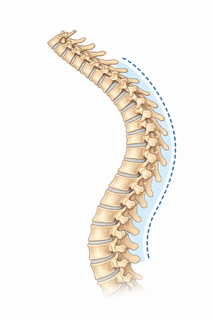
Hyperkyphosis—an increased curve in the mid-back—is something I see daily many years in clinic as a chiropractor at Active Health in Portsmouth UK. It gives the appearance of ‘rounded shoulders’ and a more forward head position. The curve in the mid-back of your spine should ideally be gentle.
Some people develop hyperkyphosis gradually from lifestyle habits. Others simply develop it due to genetics or age-related factors.
If you feel you might have a hyperkyphotic spine, you may be thinking:
- “There must be something wrong with my spine”
- “I just can’t keep my shoulders back”
- “I can’t help hunching even though my wife/husband keeps telling me to stand up straight (I hear this a lot!)”
Hyperkyphosis is common and often manageable—but without proper support it can get worse over time
The aim of this page is to help you understand:
- What hyperkyphosis actually is
- Why hyperkyphosis actually leads to mid-back and shoulder blade pain
- The secondary problems it can create (neck, rib and shoulder issues)
- Practical ways to reduce strain using exercise, workstation set up and supportive equipment
- Products available that I personally use and recommend
This isn’t about “standing up straight”. It’s about understanding your spinal structure and managing it properly.
HOW KYPHOSIS CONTRIBUTES TO PAIN
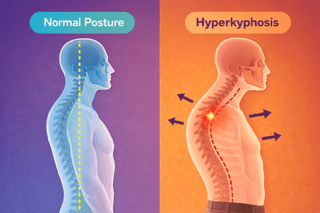
When the thoracic curve increases, several mechanical changes occur:
- The head drifts forward
- The shoulder blades sit further apart and tilt forwards
- Rib joints experience altered loading
- Mid-back joints become stiff in extension
This combination often produces:
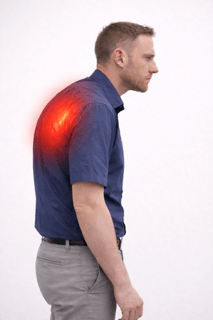
- Persistent aching between the shoulder blades
- A deep, hard-to-reach discomfort
- Muscle fatigue when sitting upright
- Neck tension and headaches
- Increased risk of rib joint irritation
Our thoracic spine is meant to move.
But with hyperkyphosis, extension (straightening backward) becomes limited—meaning certain joints and muscles work overtime.
- Gradually that overload becomes painful
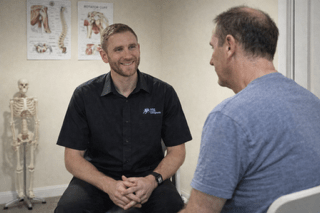
CLINIC NOTE: Patients with a more rounded upper back think they are ‘just tight’ or “just slouching all the time”.
But when I assess them, it’s not laziness or bad habits.
It’s:
- Structural spinal shape
- Long-term stiffness
- Muscular weakness in the mid-back
I often say to them:
“You’re not failing at posture. Your structure just needs managing differently”.
That small shift in understanding reduces a lot of frustration.
COMMON PROBLEMS LINKED TO HYPERKYPHOSIS
- Mid-back (Thoracic) Stiffness
The more curved the spine is, the harder it is to extend (straighten up).
This stiffness often leads to:
- A constant pulling sensation
- Reduced rotation
- Discomfort when sitting
CLINIC NOTE: Without regular mobility work, stiffness builds gradually
- Rib Joint Irritation
Because the ribs attach directly to the spine, increased curvature changes how those joints move.
I’ve noticed over the years how hyperkyphotic patients are more prone to rib joint issues.
These can cause:
- Sharp pain on breathing
- Pain when twisting
- ‘Stuck’ sensation under the shoulder blade
- Pain worse when lying
- Pain radiating around the rib cage
If you feel this might be you, visit my page on RIB JOINT IRRITATION.
- Shoulder blade movement problems
When the upper back rounds, the shoulder blades tip forward and outward.
This alters muscle balance and may cause:
- Clicking or grinding sensations
- Catching pain when lifting
- Fatigue on overhead activities
- Increased strain/tension in the lower neck
The shoulder blades rely on a stable thoracic base.
If that base is excessively curved, mechanics suffer.
WHY POSTURE CORRECTION ALONE FAILS
Many patients tell me:
“I try to pull my shoulders back but I can’t hold it.”
That’s because forcing a rigid upright posture:
- Fatigues the mid-back muscles
- Increases tension
- Is not sustainable
Rather than chasing ‘perfect posture’, focus on:
- Supportive Positioning
- Movement Variation
- Reducing prolonged strain
This is where the right setup makes a huge difference.
WORKSTATION SETUP FOR HYPERKYPHOSIS
I only recommend equipment that:
- I use personally in clinic or at home
- Has clear biomechanical benefit
- I would be comfortable recommending to my own patients or family
Standing desks:
Alternating between sitting and standing reduces sustained thoracic flexion. A good standing desk allows:
- Position changes through the day
- Reduced spinal compression that comes with prolonged sitting
- Promotes active postural control when standing
CLINIC NOTE: Patients who have invested in a quality height-adjustable desk have consistently reported that they use it more than expected and feel better for having the option to alternate positions throughout the day.
For patients with hyperkyphosis, I prioritise adjustable head support and thoracic recline. The height transition also needs to be smooth. This model provides this as well as having memory height settings. LINK to Desktronic desk

PIC OF ME with Desktronic desk or video
A standing desk is helpful for many people—but if you struggle with prolonged standing due to lower limb or lumbar pain, it may not be appropriate without gradual adaptation
Ergonomic Chairs:
For patients with hyperkyphosis, chairs must support more than just the thoracic spine
A suitable chair should provide:
- Adjustable headrest support (to reduce forward head strain)
- Adjustable lumbar pillow (to help maintain a neutral spine)
- Adjustable armrests (to reduce shoulder blade loading)
- Recline function (this reduces spinal load)
I recommend models that meet those features—this is one I suggest LINK because every section is adjustable to suit the shape and size of different spines.
Back supports for chair or car
A portable back support helps maintain a more neutral spine and reduces sustained slouching positions.
These are especially useful for:
- Long commutes
- Office chairs without proper shaping (and hot desking!)
- Travel situations
I recommend compact models that are firm but lightweight enough for commuting or flights. This is an example of the type I use when travelling. LINK
Lie down laptop tables
One strategy I personally use is varying positions completely. If you work from home, working briefly while lying supported can offload the thoracic spine and reduce sustained muscle activation.
I personally use this one LINK because it allows screen height adjustment and rotation

DOES EXERCISE HELP WITH HYPERKYPHOSIS?
The right postural equipment reduces load.
But mobility and strength determine resilience.
These are two important points that I am always emphasising to my patients.
For hyperkyphosis, key focuses include:
- Thoracic extension mobility
- Scapular stability exercises
- Postural endurance training
For a range of appropriate exercises for all levels, visit my exercise pages LINK
When it comes to exercise for hyperkyphosis, I would always say that consistency beats intensity.
Small daily exercise habits prevent long-term overload.
WHEN TO SEEK FURTHER ADVICE

While most cases of hyperkyphosis are structural or postural and manageable with the right approach, further assessment is important if you notice:
- Sudden worsening of curvature
- Sharp pain after minor trauma
- Persistent night pain
- Unexplained weight loss or fatigue
- Rapid progression in teenagers
CLINIC NOTE: In older adults, especially post-menopausal women, increasing thoracic curvature combined with pain should be assessed to rule out compression fractures. Osteoporotic compression fractures can sometimes present subtly. They do not always follow a major fall or dramatic injury. In some cases, the trigger may be something as minor as bending or lifting.
Early in my career, I missed a compression fracture in a patient whose symptoms initially appeared mechanical. It was a valuable and humbling lesson. If you are a post-menopausal woman with new or worsening thoracic pain, especially if it feels different from your usual symptoms, do not ignore it. Get it properly assessed.3
FINAL THOUGHTS
Hyperkyphosis changes spinal motion—but it doesn’t mean you are destined for a lifetime of pain.
The key principles are:
- Understand your structure
- Support it properly
- Keep it moving appropriately
- Reduce prolonged load
WHAT DO TO NEXT
- Explore the Thoracic Mobility Exercise Page
- Review the Appropriate Linked Conditions Pages
- Assess your Workstation and Daily Setup
Managing hyperkyphosis isn’t about perfection…it’s about consistency and smart adjustments.
Medical Disclaimer: This page is for educational purposes only and does not replace individual medical assessment or advice.
Affiliate Disclosure: Some links on this page are affiliate links ,meaning I may earn a small commission at no extra cost to you. I only recommend equipment that I use personally in clinic or would advise to my own patients.
 Active Health Hub