
Understanding rib-related joint pain
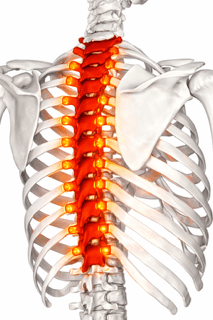
If you’ve landed on this page, there’s a good chance your symptoms sound something like this:
- “It feels like a sharp knife under my shoulder blade”
- “It catches when I twist”
- “It hurts when I take a deep breath”
- “It’s just out of reach!”
- “It radiates around my rib cage”
One of the most common causes of these symptoms is irritation of a rib joint — medically known as the costovertebral or costotransverse joints.
Over the years in clinic as a chiropractor at Active Health in Portsmouth, I’ve treated well over 100 cases of rib joint irritation.
They can be extremely painful—but in most cases they settle quickly when the right conditions are restored.
The aim of this page is to help you understand:

- What rib joint pain actually is
- What causes rib joint problems
- What are the common patterns of a rib joint problem
- How to settle rib joint pain
- When to seek further help
WHAT EXACTLY IS A RIB JOINT PROBLEM?
There are 12 ribs attaching to 12 thoracic vertebrae (the bones in your mid-back). That’s 24 rib joints at the back alone (before we even count the spinal joints).
Each rib attaches to the spine at two small joints. It’s a busy area. When one small joint isn’t moving properly, it doesn’t stay quiet for long.
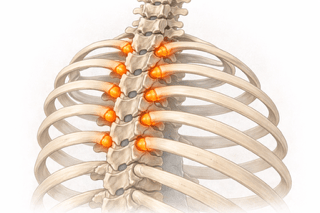
These joints:
- Help you rotate and bend
- Expand when you breathe in
- Work closely with the muscles around your shoulder blade
When one becomes stiff or irritated, the surrounding muscles often tighten protectively. That’s usually when people feel:
- A sharp localised pain
- A “locked” or stuck sensation
- Pain when breathing deeply
- Pain lying on one side
- Discomfort twisting in the car or reaching behind

It can feel dramatic… but most rib joint problems are mechanical and very manageable.
WHAT CAUSES RIB JOINT PROBLEMS?
In clinic, the common themes I see are:
1. Prolonged Sitting and Desk Work
The thoracic spine is designed to move. Long periods at a laptop — especially in a rounded posture—gradually reduce that movement and increase joint stiffness.
If you’re desk-based, a few simple changes help enormously:
- Alternating with a standing desk to reduce prolonged sitting
- Using a supportive ergonomic chair with proper lumbar support
- Adding a portable back support for driving or non-supportive chairs
If you’d like to see some of the ergonomic products that I recommend to my patients, visit my products page LINK
PIC OF ME WITH NEW STANDING DESK
2. Sudden Awkward Movements
Reaching into the back seat of the car. Twisting while lifting. An enthusiastic gym session after a long break.
Rib joints don’t enjoy sudden rotational load when they’ve been stiff for weeks.
3. Poor Sleep Position or Mattress Support
Sleeping twisted or on an unsupportive surface can irritate the joints overnight.
Check:
- Is your mattress supportive and not sagging?
- Is your pillow keeping your neck aligned (not pushing your head too far forward)?
Small changes here can reduce repeated irritation. I recommend this pillow LINK for good neck and upper-back alignment when sleeping
4. Reduced Thoracic Mobility
If your mid-back loses mobility, the rib joints are forced to take more load. Over time, one can become irritated.
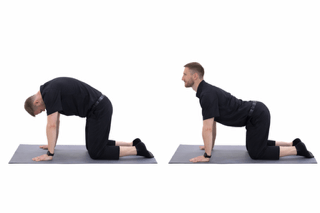
This is why gentle, consistent thoracic movement is so important—not aggressive stretching, just regular motion.
TRUE STORY:
In my final year studying at the Anglo European College of Chiropractic, I developed my first rib joint issue after long hours revising in a terrible position.
Sharp pain. Felt like something poking under my shoulder blade. Muscles went into full spasm around the joint.
Treatment settled it quickly — but the lesson stuck with me:
Stiffness + sustained posture + stress = irritated rib joint.
WHAT ARE THE COMMON PATTERNS OF A RIB JOINT PROBLEM?
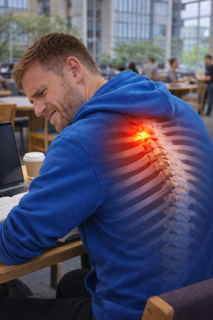
While assessment is always best, in my experience, rib joint irritation commonly has one or more of the following symptoms:
- Feels very localised (you can point to it with one finger)
- Hurts more with deep breath or cough
- Worsens with twisting one direction
- May ease temporarily with movement or heat
- Pain worse when lying
It’s less likely to:
- Radiate far down the arm
- Cause pins and needles in the fingers
- Feel unstable at the shoulder itself
If your symptoms fit more with grinding, catching or shoulder weakness, you may want to explore the Shoulder Blade Movement Issues page next.
How to settle rib joint pain?
Step 1: Reduce Acute Irritation
If it’s flared up:
- Apply an ice pack for 10–15 minutes to calm irritation
- Avoid aggressive stretching early on
- Modify painful twisting movements
Ice won’t “fix” the joint but I find it helps reduce the muscle spasms around it which are a great source of the pain.
Step 2: Restore Gentle Movement
Once acute pain settles slightly, you can slowly introduce:
- Gentle thoracic mobilisation exercises
- Controlled extension exercises LINK
- Light resistance exercises using exercise band to retrain scapular control LINK
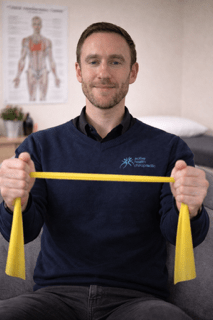
The aim is coordinated movement to encourage movement of the ‘stuck’ rib.
Step 3: Improve Daily Load Management
This is where many people relapse — not because treatment failed, but because daily strain didn’t change.
Consider:
- Alternating sitting and standing with a standing desk LINK
- Ensuring your ergonomic chair supports the thoracic curve LINK
- Using a portable back support for driving LINK
- Checking your mattress isn’t collapsing into flexion
- Changing your pillow to help with spinal alignment LINK
None of these are magic bullets.
But together? They significantly reduce repeated irritation.
WHY POSTURE ALONE ISN’T THE ANSWER
I often hear:
“I’m trying to sit up straight but I can’t hold it.”
Rigid posture isn’t realistic — and often not suitable for your spinal shape.
A better strategy:
- Find comfortable supported positions
- Change them regularly
- Keep the thoracic spine moving daily
Movement beats military posture every time.

WHEN SHOULD YOU SEEK HELP?
Consider professional assessment if:
- Pain is severe or not settling
- Breathing pain persists
- Symptoms repeatedly return
- You’re unsure whether it’s rib, disc, or shoulder-related
FINAL THOUGHTS
Rib joint irritation is one of the most common causes of mid-back and shoulder blade pain I see.
The pain can be extremely sharp and worrying—especially when breathing feels restricted—but in most cases it settles down and makes a full recovery.

Next steps:
- Use the links on this page to explore the related condition pages to gain greater clarity
- Try one or two of the exercises linked on this page and progress from there
- Check the recommended products page for ergonomic improvements that will help prevent future problems
Medical Disclaimer:
This page is for educational purposes only and does not replace individual medical assessment or advice.
Affiliate Disclosure:
Some links on this page are affiliate links meaning I may earn a small commission at no extra cost to you.
 Active Health Hub